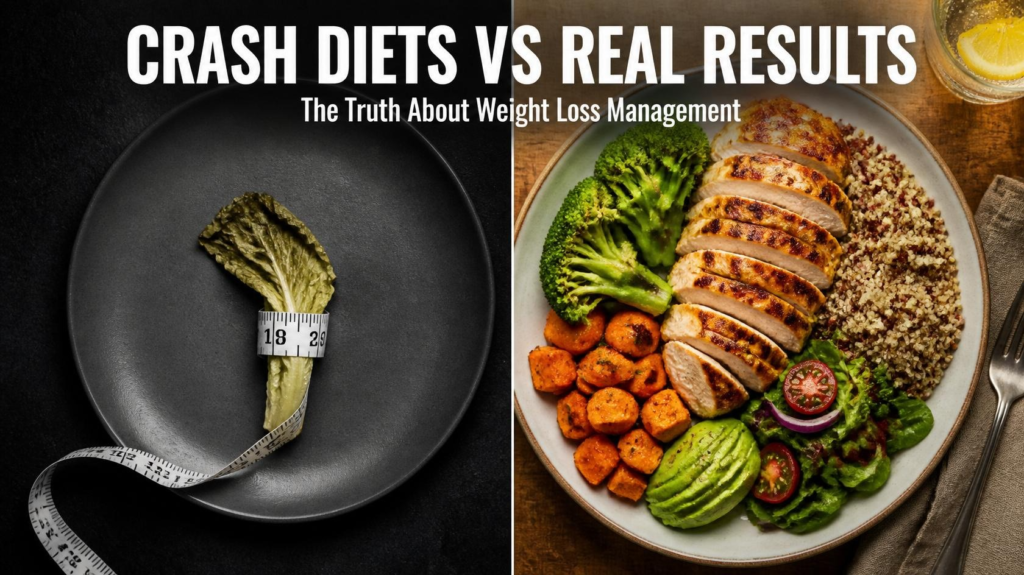
You’ve probably seen the promise before: lose 10 kg in 10 days. It sounds tempting, especially when you want results fast. But here’s the uncomfortable truth — almost everyone who tries a crash diet ends up back where they started, sometimes heavier than before. The problem isn’t willpower. It’s the approach itself.
This article breaks down exactly why crash diets fail biologically and psychologically, and what actually works when it comes to long-term weight management.
What Exactly Is a Crash Diet?
A crash diet is any extreme, short-term eating plan that drastically cuts calories — often below 800–1000 calories a day — promising rapid weight loss in days or weeks. Think juice cleanses, single-food diets, or “detox” plans that eliminate entire food groups overnight.
They work in the short term, technically. You do lose weight fast. But most of it isn’t fat — it’s water, glycogen stores, and in many cases, muscle mass. That distinction matters more than most people realize.
Why Crash Diets Fail: The Science
1. Your Body Fights Back
When calorie intake drops too low too fast, your body interprets it as a threat, not a diet. It responds by slowing down your metabolic rate to conserve energy — a survival mechanism that’s been hardwired into humans for thousands of years. This means the longer you stay on a crash diet, the harder your body works to hold onto every calorie you eat.
2. Muscle Loss Slows Everything Down
Severe calorie restriction doesn’t just burn fat — it burns muscle too, especially without adequate protein or strength training. Since muscle tissue burns more calories at rest than fat tissue, losing it actually lowers your daily calorie burn, making future weight loss harder, not easier.
3. Hunger Hormones Go Into Overdrive
Crash dieting disrupts ghrelin and leptin — the hormones responsible for hunger and fullness. This is why people often report feeling ravenously hungry, sometimes for weeks after stopping a crash diet, which frequently leads to rebound overeating.
4. It’s Mentally Unsustainable
Extreme restriction creates an all-or-nothing mindset. One “slip” often feels like total failure, which triggers giving up entirely — a pattern far more common with rigid, restrictive diets than with balanced, flexible ones.
According to Harvard T.H. Chan School of Public Health, diets that are overly restrictive tend to have poor long-term adherence, and sustainable weight loss is more closely linked to consistent, moderate changes than extreme short-term restriction.
The Yo-Yo Effect: Why Weight Comes Back
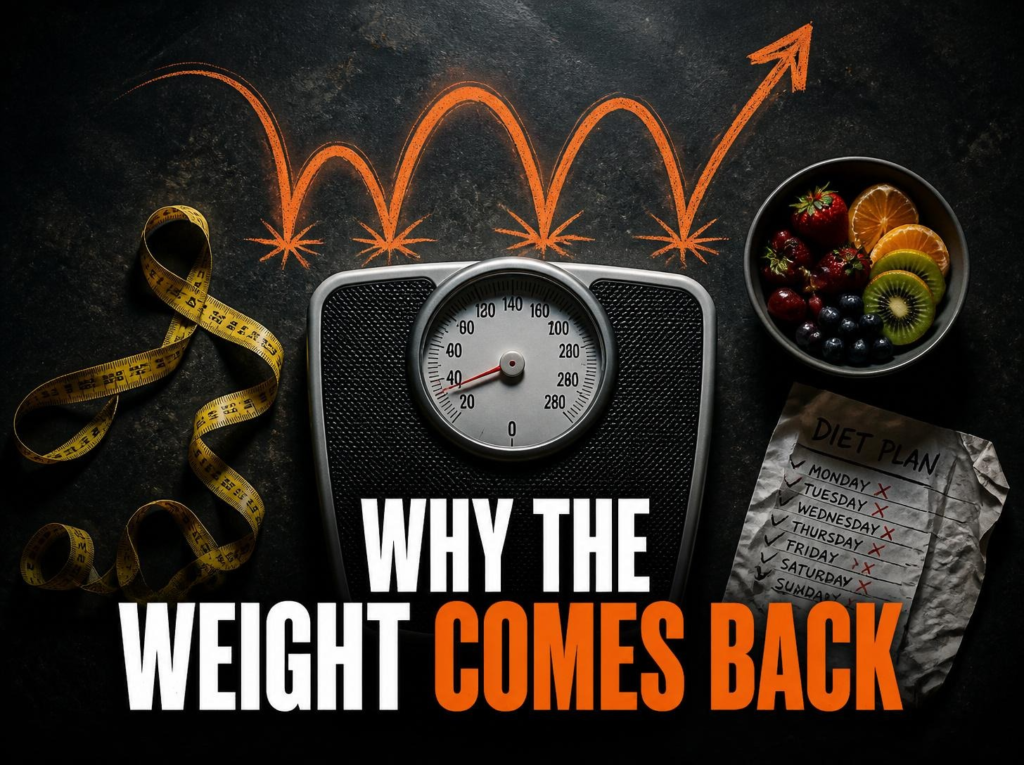
This cycle has a name — yo-yo dieting — and it’s one of the most damaging patterns for long-term health. Here’s the typical sequence:
- Crash diet causes rapid initial weight loss
- Metabolism slows down as a protective response
- Diet ends (because it’s unsustainable) and normal eating resumes
- Slower metabolism + hormonal hunger signals = rapid weight regain
- Often, the person ends up slightly heavier than their starting point
Each cycle can make the next attempt at weight loss harder, which is exactly why so many people feel “stuck” despite trying diet after diet.
What Actually Works: Real Weight Loss Management
The alternative to crash dieting isn’t complicated — it’s just less exciting to market. Genuine weight loss management focuses on moderate, sustainable changes instead of extreme short-term fixes.
Moderate Calorie Deficit
A deficit of 300–500 calories a day is enough to produce steady fat loss (roughly 0.5–1 kg per week) without triggering the metabolic slowdown seen in crash diets.
Adequate Protein Intake
Protein preserves muscle mass during weight loss and keeps you fuller for longer, reducing the urge to overeat later in the day.
Consistency Over Intensity
Small, repeatable habits — a daily walk, home-cooked meals, regular sleep — outperform extreme short bursts of restriction because they don’t rely on willpower alone.
Flexibility, Not Rigidity
A plan that allows for the occasional celebration, festival, or off day is far more sustainable than one that demands perfection every single day.
How a Structured Plan Prevents the Crash-Diet Trap
The biggest difference between a crash diet and a proper plan isn’t the goal — both aim for weight loss. The difference is in the approach: personalized weight loss services adjust your calorie targets, macros, and meal structure based on your body’s actual response over time, rather than forcing an arbitrary number that ignores how your metabolism is reacting.
This is exactly why working with a structured, guided plan tends to produce results that last — because the plan adapts to you, instead of expecting you to survive on an unsustainable extreme.
Signs You’re on a Crash Diet (Even If You Don’t Realize It)
- You’re eating fewer than 1000–1200 calories a day without medical supervision
- You’ve eliminated an entire food group (carbs, fats) completely
- You feel intense hunger, irritability, or fatigue most of the day
- The plan promises a specific, dramatic result within days
- You can’t imagine following this way of eating for more than a few weeks
If two or more of these sound familiar, it might be time to shift toward a more sustainable approach.
Final Thoughts
Crash diets fail because they fight against biology, not because people lack discipline. Your body is designed to protect itself from sudden, extreme restriction — which means the harder and faster you push, the harder it pushes back.
Real, lasting results come from consistent, moderate weight loss management — not from punishing your body for a few weeks and hoping it sticks. Slow progress that stays is always better than fast progress that reverses.